Artificial intelligence has created an entirely new generation of technology companies. But few have attracted as much attention as Palantir Technologies.
The company is frequently mentioned alongside AI, big data, government technology, defense, and enterprise software. Its platforms are used by organizations dealing with enormous amounts of information and complex operational decisions. Yet despite its growing profile, Palantir can be difficult to understand from the outside.
Is it an AI company? A data company? A defense contractor? A software company?
The answer is a little more complicated.
Palantir describes itself as a software company, and its platforms are designed to connect data, analytics, AI, and real-world operations. Its technology is used across commercial and government environments, ranging from healthcare and manufacturing to defense and logistics. (Palantir)
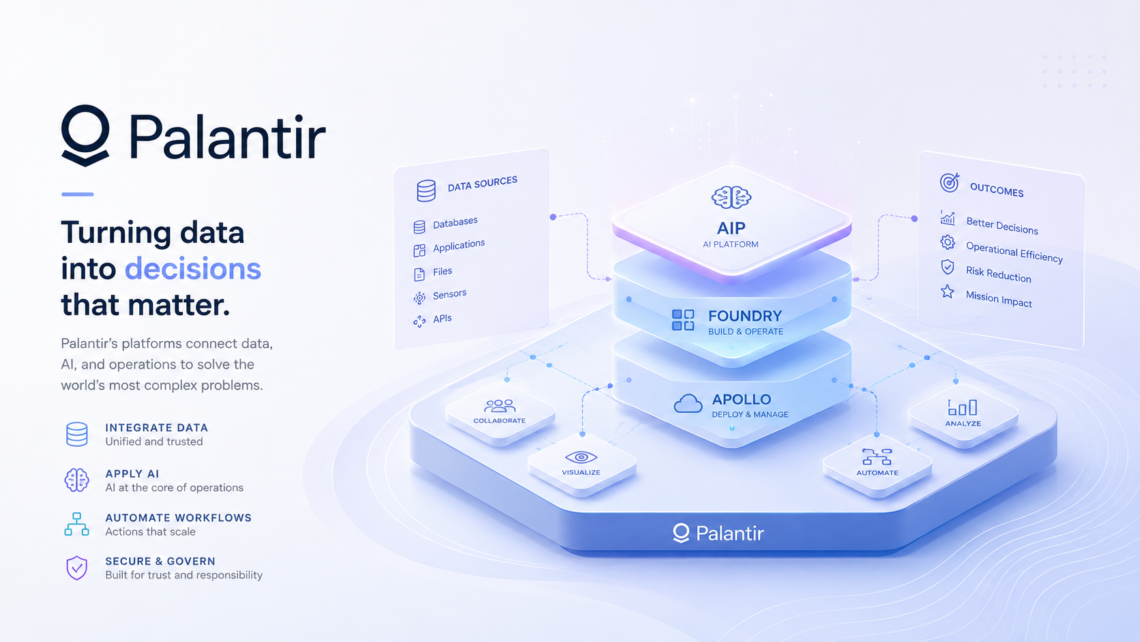
At the center of Palantir’s modern platform strategy are Foundry, Gotham, AIP, and Apollo. Together, these technologies are designed to give organizations a way to understand their data, build applications, deploy AI, and turn information into operational decisions.
So, what exactly does Palantir do?
What Is Palantir?
Palantir Technologies is a software company focused on helping organizations work with complex data and operational systems.
Rather than simply storing information, Palantir’s platforms are designed to connect information from different sources and turn it into something employees and AI systems can actually use.
Imagine a large manufacturer.
It might have separate systems containing information about:
- Factories
- Suppliers
- Inventory
- Orders
- Employees
- Machines
- Transportation
- Customers
The problem isn’t necessarily that the information doesn’t exist. The problem is that it can be scattered across dozens of different systems.
Palantir attempts to create a unified operational view of that information.
This approach becomes particularly important when organizations begin introducing AI. An AI model can generate impressive responses, but it needs access to relevant and reliable information to make useful decisions.
That’s where Palantir’s AI platform enters the picture.
Palantir’s Main Platforms
Palantir currently describes its core architecture around AIP, Foundry, and Apollo, while Gotham provides a major platform for defense and other decision-making applications. (Palantir)
| Platform | Main Purpose |
|---|---|
| Foundry | Data operations, analytics and workflows |
| AIP | Generative AI, agents and AI-powered applications |
| Gotham | Decision-making and defense applications |
| Apollo | Software deployment and infrastructure management |
These platforms aren’t isolated products. They’re designed to work together.
Palantir Foundry
Foundry is essentially the data and operational foundation of the Palantir ecosystem.
It allows organizations to bring together information from different systems and build applications and workflows around that data.
One of the most important concepts inside Foundry is the Ontology.
Rather than treating enterprise information as disconnected tables and databases, the Ontology represents real-world objects and relationships.
For example, a manufacturing organization could have objects representing:
Factory → Production Line → Machine → Product → Order → Customer
These objects can then be connected to actions and business logic.
This makes the data easier for humans—and increasingly AI systems—to understand and interact with. Palantir describes the Ontology as the layer that connects an organization’s data, logic, actions, and security policies. (Palantir)
Diagram Placeholder: Show raw enterprise data flowing into Foundry → Ontology → applications, analytics, workflows, and AI.
Palantir Gotham
While Foundry has a strong presence in commercial environments, Gotham has historically been associated with government, defense, intelligence, and complex operational decision-making.
Palantir describes Gotham as an operating system for global decision-making. Its applications can bring together information from different sources to give operators a more complete picture of a situation. (Palantir)
For example, organizations operating in complicated environments may need to analyze information from:
- Sensors
- Satellites
- Vehicles
- Intelligence systems
- Maps
- Communications
- Field operations
Gotham is designed to help users connect those sources and make decisions using a shared operational picture.
This is one of the reasons Palantir has become particularly well known in defense and government technology.
What Is Palantir AIP?
The most interesting part of Palantir’s current technology story is arguably AIP, or the Artificial Intelligence Platform.
AIP is designed to connect large language models and other AI technologies to an organization’s real operational data and workflows.
Instead of having an AI chatbot that simply answers general questions, businesses can use AIP to build AI-powered workflows and agents that interact with their organization’s information and systems.
Palantir says AIP supports tools for building production AI workflows, agents, applications, and functions on top of its Ontology and developer toolchain. (Palantir)
That distinction is important.
A normal chatbot might answer:
“What is our inventory policy?”
An enterprise AI system connected to the company’s operational data could potentially answer a much more useful question:
“Which warehouses are likely to run out of this product next week, and what should we do about it?”
The second problem requires access to real business data, business rules, and operational systems.
That’s the territory Palantir is targeting.
How Palantir Uses AI
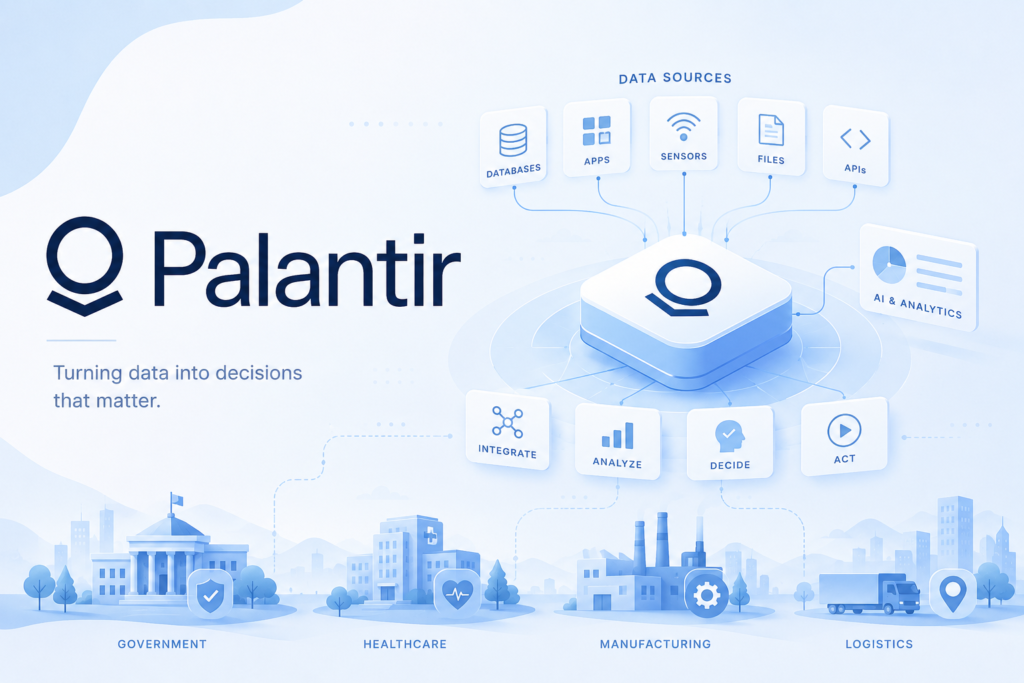
Palantir’s approach isn’t simply about putting a chatbot on top of a database.
AIP can connect AI models to the Ontology, allowing AI-powered applications and agents to work with structured organizational context. The platform also includes tools for monitoring, evaluating, governing, and managing AI workflows. (Palantir)
This can enable applications such as:
- AI-powered data analysis
- Automated workflows
- Enterprise chatbots
- AI agents
- Decision-support systems
- Predictive analytics
- Operational automation
Palantir also supports multiple model providers rather than requiring customers to use one particular AI model. Its documentation lists support for models from providers including OpenAI, Anthropic, Google, and xAI, alongside other model options. (Palantir)
That gives organizations more flexibility when selecting models for different applications.
Why the Ontology Matters
The Ontology is arguably one of the most important concepts to understand when looking at Palantir.
Traditional enterprise software often leaves data scattered across different applications.
An AI model doesn’t automatically understand how all those systems relate to each other.
The Ontology creates a structured representation of the organization’s operational world.
For example:
Customer
↓ places
Order
↓ contains
Product
↓ produced by
Factory
↓ depends on
Supplier
An AI system can then work with these relationships instead of simply searching through disconnected documents.
This is one reason Palantir positions its technology as an operational platform rather than simply another AI chatbot.
Where Is Palantir Used?
Palantir’s platforms are used across government and commercial industries.
The company says its technology spans more than 50 verticals, including healthcare, energy, manufacturing, insurance, and defense. (Palantir)
Potential applications include:
Healthcare
Hospitals can use integrated data to understand operations, manage resources, and build AI-assisted workflows.
Manufacturing
Factories can combine information about production, inventory, equipment, and supply chains.
Energy
Utilities can analyze complex operational data and respond to changing conditions.
Defense
Organizations can use software to integrate information and support decision-making in demanding environments.
Logistics
Companies can use connected data to optimize transportation, inventory, and supply networks.
Palantir and Enterprise AI
One reason Palantir has become particularly interesting during the AI boom is that many businesses have discovered that simply purchasing an AI model isn’t enough.
A company can have access to an extremely capable large language model, but it still needs to solve several problems:
Where is the company’s data?
Who is allowed to access it?
How should the AI use that information?
What actions can the AI take?
How can those actions be monitored?
How do you prevent an AI system from making unauthorized changes?
Palantir’s platform attempts to address these problems through data integration, permissions, governance, AI tooling, and operational workflows.
Its AIP architecture includes security controls, auditing, observability, model management, and tools for evaluating AI workflows. (Palantir)
Palantir’s Growth as a Software Company
Palantir has also experienced substantial business growth alongside the broader interest in enterprise AI.
In its first quarter of 2026, Palantir reported $1.6 billion in revenue, up 85% from the same quarter a year earlier. Its filing reported 1,007 customers based on its trailing-twelve-month definition at March 31, 2026. (Palantir Investor Relations)
The company’s revenue during that quarter was split between government and commercial customers, with 53% coming from government customers and 47% from commercial customers. (Palantir Investor Relations)
These figures illustrate why Palantir has become an important company to watch in enterprise software and AI.
However, revenue growth alone doesn’t explain the company’s technology.
The bigger story is how Palantir is attempting to position its software as an operating layer connecting data + AI + applications + real-world operations.
What Makes Palantir Different?
There are many companies working on AI, cloud computing, analytics, and enterprise software.
Palantir’s differentiation is its attempt to combine these areas into an integrated platform.
Instead of selling only:
AI model
or
Data warehouse
or
Analytics dashboard
Palantir aims to connect these pieces into a larger operational system.
Its architecture combines Foundry, AIP, and Apollo, with Gotham serving important decision-making use cases. (Palantir)
This integrated approach can be particularly valuable for organizations with complicated infrastructure and highly sensitive information.
The Challenges Facing Palantir
Palantir’s technology is impressive, but the company isn’t without challenges.
Enterprise software is highly competitive, and companies can choose from cloud providers, data platforms, AI vendors, analytics companies, and specialized software providers.
There are also questions around the complexity and cost of deploying sophisticated enterprise platforms.
Another challenge is the nature of Palantir’s government business. Government contracts can be large, but spending decisions can depend on budgets, procurement processes, and political priorities. Palantir itself notes these uncertainties in its filings. (Palantir Investor Relations)
And because Palantir works with sensitive data and government organizations, questions around privacy, security, surveillance, and responsible use of technology remain important parts of the broader discussion surrounding the company.
The Future of Palantir
The future of Palantir will likely depend heavily on how successfully organizations move from experimenting with AI to actually deploying it inside their operations.
The company is already expanding its AI capabilities beyond traditional chat interfaces.
For example, Palantir’s AI FDE can interpret natural-language requests and perform tasks within Foundry, including working with data pipelines, repositories, Ontology objects, functions, and governance processes. (Palantir)
Palantir has also introduced AI-powered tools such as AIP Analyst and Pilot for building and interacting with applications. (Palantir)
This points toward a future where employees don’t necessarily need to understand every technical layer underneath an enterprise system.
Instead, they may simply describe what they want to accomplish, while AI agents interact with the underlying data and software.
Final Thoughts
Palantir is much more than an AI chatbot company.
Its core strategy revolves around connecting an organization’s data, operations, software, and artificial intelligence into a unified environment. Foundry provides the data and operational foundation, Gotham supports complex decision-making, AIP brings generative AI and agents into the picture, and Apollo helps manage software deployment across different environments.
As companies increasingly move from experimenting with AI to deploying it in real business processes, platforms capable of securely connecting AI to operational data could become increasingly important.
That is ultimately what makes Palantir such an interesting technology company to watch. Its biggest opportunity may not be simply building another powerful AI model—it may be helping organizations turn the models that already exist into useful tools that can actually understand their business and participate in real-world operations.