Understanding the Technologies Shaping Our Future
Machine Learning Artificial Intelligence technologies are no longer futuristic concepts confined to science fiction movies—they’re technologies that influence our daily lives in ways many people don’t realize. Whether you’re asking a virtual assistant for directions, receiving personalized recommendations on Netflix, unlocking your smartphone using facial recognition, or using an AI-powered chatbot for customer support, these technologies are working behind the scenes.
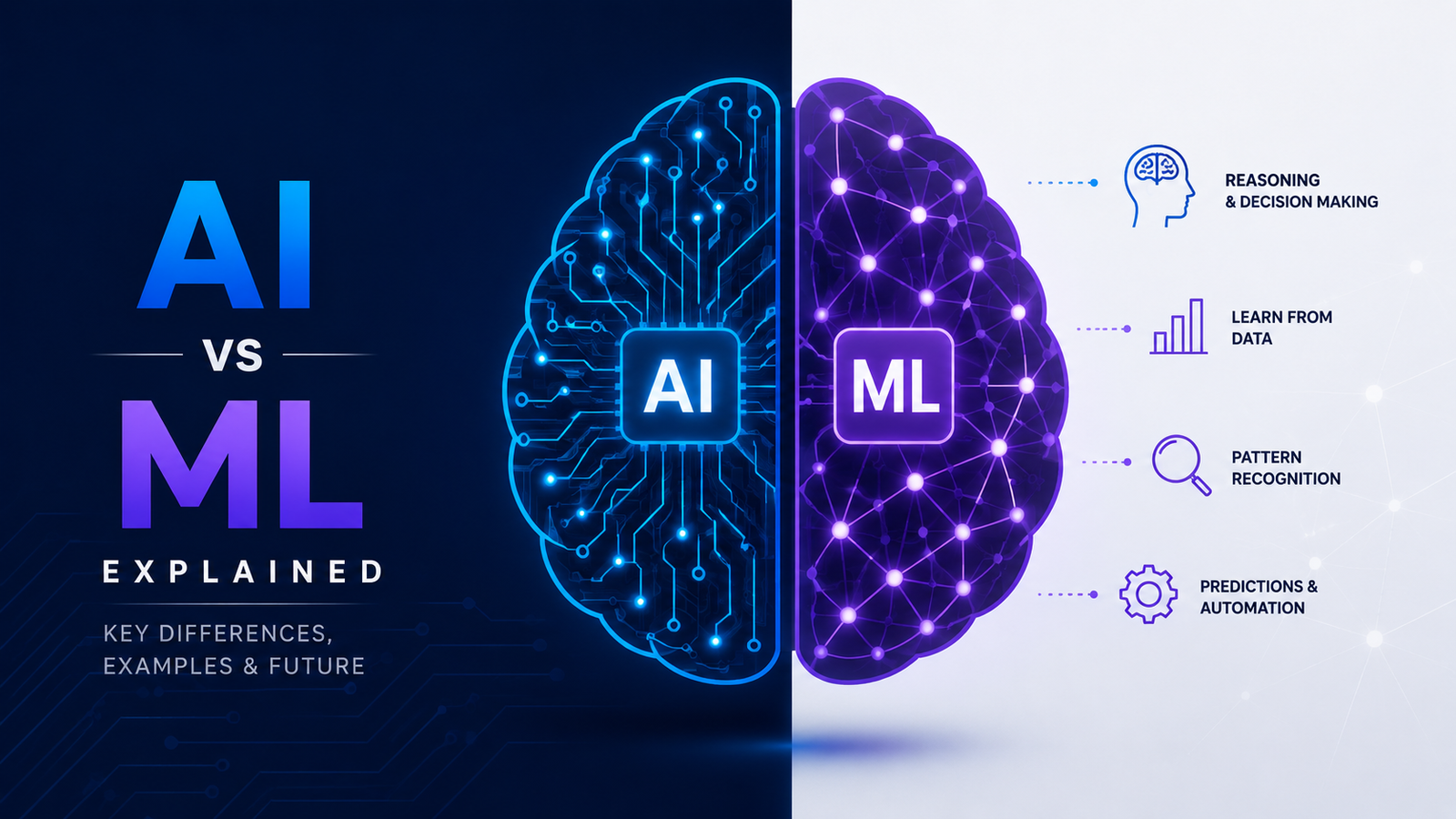
Despite their growing popularity, AI and Machine Learning are often misunderstood or used interchangeably. While closely related, they are not the same thing. Artificial Intelligence is the broader concept of creating machines capable of performing tasks that typically require human intelligence, while Machine Learning is a specialized branch of AI that enables systems to learn from data instead of relying solely on predefined rules.
As businesses across industries adopt AI to improve efficiency, automate repetitive tasks, and make better decisions, understanding these technologies has become increasingly valuable. In this guide, we’ll break down what Artificial Intelligence and Machine Learning are, how they work, where they’re used, and why they’re shaping the future of nearly every industry.
What Is Artificial Intelligence?
Artificial Intelligence refers to computer systems designed to perform tasks that normally require human intelligence. These tasks include recognizing speech, understanding language, solving problems, analyzing images, making decisions, and even generating creative content.
Unlike traditional software that follows a fixed set of instructions, AI systems can adapt, recognize patterns, and improve their performance over time.
Modern AI powers countless technologies, including:
- Voice assistants
- Search engines
- AI chatbots
- Recommendation systems
- Self-driving vehicles
- Smart home devices
- Fraud detection systems
If you’re interested in conversational AI, our AI Chatbots for Customer Service guide explains how businesses use intelligent assistants to improve customer experiences.
What Is Machine Learning?
Machine Learning is a branch of Artificial Intelligence that focuses on enabling computers to learn from data without being explicitly programmed for every possible situation.
Instead of writing thousands of rules, developers train machine learning models using large datasets. The system analyzes patterns, learns relationships, and gradually improves its predictions as it processes more information.
For example, instead of manually defining what every cat looks like, a machine learning model can study millions of cat images and eventually recognize new ones on its own.
This ability to learn from experience makes Machine Learning one of the most powerful technologies driving modern AI.
AI vs Machine Learning
Although the terms are frequently used together, they describe different concepts.
| Artificial Intelligence | Machine Learning |
|---|---|
| Broad field of computer intelligence | Subset of AI |
| Simulates human intelligence | Learns from data |
| Includes reasoning and decision making | Focuses on prediction and pattern recognition |
| Can use rule-based systems | Relies heavily on data |
| Larger umbrella technology | One approach within AI |
Think of Artificial Intelligence as the goal of creating intelligent machines, while Machine Learning is one of the most effective methods used to achieve that goal.
How Machine Learning Works
Machine learning follows a structured process that allows computers to improve over time.
Step 1: Data Collection
Everything begins with data. This may include images, text, videos, customer records, financial transactions, or sensor information.
The quality of the data has a significant impact on the accuracy of the final model.
Step 2: Training
The data is used to train an algorithm for Machine Learning Artificial Intelligence, recognizing patterns and relationships.
During training, the model adjusts itself repeatedly until it can make accurate predictions.
Step 3: Testing
After training, the model is evaluated using new data it has never seen before.
This ensures the AI can perform well in real-world situations.
Step 4: Prediction
Once deployed, the model analyzes incoming information and produces predictions or recommendations.
Examples include identifying spam emails, recognizing faces, detecting fraud, or recommending products.
Types of Machine Learning
Machine Learning is generally divided into four categories.
Supervised Learning
The model learns using labeled examples.
Example:
Teaching a system to recognize dogs using images already labeled as “dog.”
Unsupervised Learning
The AI discovers hidden patterns without predefined labels.
Example:
Grouping customers based on purchasing behavior.
Reinforcement Learning
The AI learns by receiving rewards or penalties for its actions.
Example:
Training robots or game-playing AI systems.
Deep Learning
Deep Learning uses neural networks with multiple layers to solve highly complex problems such as image recognition, language translation, and speech synthesis.
Today’s AI image generators, virtual assistants, and autonomous vehicles rely heavily on deep learning models.
Real-World Applications
Artificial Intelligence has become part of everyday life.
Healthcare
Hospitals use AI to analyze medical scans, detect diseases earlier, and assist doctors in making treatment decisions.
Finance
Banks rely on AI to identify fraudulent transactions, assess financial risks, and automate customer support.
Retail
Online stores use machine learning to recommend products based on browsing history and previous purchases.
Transportation
Self-driving vehicles use AI to recognize traffic signs, detect obstacles, and make driving decisions in real time.
Manufacturing
Factories employ AI-powered robots to inspect products, predict equipment failures, and improve production efficiency.
Education
Learning platforms personalize lessons based on each student’s progress and learning style.
Benefits of AI and Machine Learning
Artificial Intelligence offers numerous advantages across industries.
Automation
AI automates repetitive tasks, allowing employees to focus on more valuable work.
Better Decision Making
Machine learning analyzes massive datasets far faster than humans.
Improved Accuracy
AI systems reduce human error in many applications.
Personalization
Recommendation engines provide personalized shopping, entertainment, and learning experiences.
Increased Productivity
Businesses can operate more efficiently by automating customer support, data analysis, and routine workflows.
Challenges and Concerns
Despite its advantages, AI presents several challenges.
Data Privacy
AI systems require large amounts of data, raising important questions about privacy and security.
Bias
Poor-quality training data can result in unfair or inaccurate predictions.
Job Displacement
Automation may replace certain repetitive jobs while creating demand for new technical roles.
Ethical Issues
Governments and organizations continue working to establish responsible AI guidelines that promote transparency and accountability.
The Future of Artificial Intelligence
Artificial Intelligence continues to evolve at an incredible pace.
Future developments are expected to include:
- More capable AI assistants
- Smarter healthcare diagnostics
- Autonomous transportation
- AI-powered scientific research
- Personalized education
- Advanced robotics
- Intelligent wearable technology
Rather than replacing humans entirely, AI will likely become a collaborative tool that helps people work more efficiently and make better decisions.
Frequently Asked Questions
Is Machine Learning the same as Artificial Intelligence?
No. Machine Learning is a subset of Artificial Intelligence focused on learning from data.
Does AI always require Machine Learning?
No. Some AI systems use predefined rules instead of learning algorithms.
What programming languages are commonly used in AI?
Python is the most popular language due to its extensive ecosystem of AI and Machine Learning libraries, although languages like Java, C++, and R are also widely used.
Can AI think like humans?
Current AI can perform specific tasks extremely well but does not possess human consciousness, emotions, or true understanding.
Final Thoughts
Artificial Intelligence and Machine Learning have rapidly evolved from experimental technologies into essential tools that power modern businesses, healthcare, transportation, education, entertainment, and countless everyday applications. While Artificial Intelligence represents the broader vision of creating intelligent systems, Machine Learning provides the ability for those systems to improve through experience and data.
As computing power increases and access to data continues to grow, AI will become even more integrated into our daily lives. Understanding these technologies today isn’t just useful for developers or engineers—it’s valuable for anyone interested in the future of technology. Whether you’re exploring AI-powered software, learning about automation, or considering a career in technology, building a strong foundation in Artificial Intelligence and Machine Learning will help you better understand the innovations shaping the digital world.