Artificial intelligence is changing the way people work.
AI can write emails, generate images, analyze documents, create software, answer customer questions, summarize information, and automate repetitive tasks. As these systems become more capable, it’s natural for people to wonder whether AI will eventually take their jobs.
The answer isn’t as simple as “AI will replace everyone.”
AI is more likely to change jobs by automating specific tasks within them. Some careers may be heavily transformed, while others may see relatively little disruption. At the same time, entirely new jobs are likely to emerge around AI, automation, data, cybersecurity, and other technologies.
So which careers are most at risk, and which ones are likely to remain valuable?
AI Usually Replaces Tasks Before It Replaces Jobs
A job is rarely just one task.
Take an accountant, for example.
An accountant might:
- Enter financial information
- Prepare reports
- Check transactions
- Communicate with clients
- Explain financial results
- Investigate unusual transactions
- Make recommendations
AI can already help with several of these activities.
But automating one or two tasks doesn’t necessarily eliminate the entire job.
The same applies to software engineers, designers, marketers, lawyers, customer-support employees, and many other professionals.
The more realistic scenario is:
AI automates tasks → Jobs change → Workers use AI → Productivity increases
This distinction is important when discussing AI and employment.
Which Jobs Are Most Exposed to AI?
Jobs that involve repetitive, predictable, and highly digital tasks are generally more exposed to AI automation.
These jobs often involve processing information according to established rules.
Some examples include:
Data Entry
Data entry is particularly vulnerable because computers can process structured information extremely quickly.
AI-powered systems can extract information from documents, invoices, forms, and other sources without requiring someone to manually type every field.
Basic Customer Support
AI chatbots can answer common questions, provide instructions, check account information, and handle simple requests.
This doesn’t necessarily eliminate customer service entirely, but it can reduce the number of basic queries handled by human employees.
Transcription
Speech-to-text systems have become extremely capable.
Meetings, interviews, lectures, and conversations can often be transcribed automatically, reducing the need for manual transcription.
Basic Content Production
AI can generate simple descriptions, summaries, product listings, and other repetitive text.
This makes some forms of low-complexity content production more vulnerable to automation.
What About Software Engineers?
Software engineering is one of the careers most frequently discussed in the AI debate.
AI coding tools can already generate functions, write tests, explain code, find potential bugs, and help developers build applications.
That doesn’t mean software engineers are suddenly unnecessary.
Software engineering involves much more than writing code.
Developers also need to understand:
- System architecture
- Security
- Performance
- Business requirements
- Databases
- Infrastructure
- User needs
- Maintenance
- Complex debugging
AI can assist with many of these areas, but human oversight remains important.
The likely future is therefore not simply “AI replaces programmers.”
Instead, one developer using powerful AI tools may be able to accomplish considerably more work than before.
That could change the number of people needed for certain projects, particularly projects involving routine development.
Graphic Designers and Creatives
Creative work is another area experiencing major changes.
AI image generators can create illustrations, concepts, advertisements, backgrounds, and visual variations in seconds.
This creates obvious pressure on some types of design work.
For example, simple tasks such as:
- Removing backgrounds
- Creating basic social-media graphics
- Generating visual concepts
- Producing variations
- Creating simple illustrations
can increasingly be automated.
But creative professionals do more than produce individual images.
A professional designer may need to understand:
- Brand identity
- Audience psychology
- Visual communication
- Marketing objectives
- Client requirements
- Art direction
AI can generate possibilities, but deciding which possibility actually solves the client’s problem is a different challenge.
Writers and Content Creators
Writing is another field being transformed rapidly.
AI can produce articles, summaries, advertisements, product descriptions, emails, scripts, and social-media posts.
This means some repetitive writing jobs could shrink.
However, high-quality writing often involves more than putting words together.
Strong writers need to:
- Research topics
- Understand audiences
- Develop original ideas
- Build arguments
- Interview people
- Edit information
- Establish a distinctive voice
AI may therefore change the role of writers rather than completely eliminate writing as a profession.
Instead of spending hours creating a first draft, writers may increasingly use AI to generate initial material and spend more time researching, editing, verifying, and improving it.
Accounting and Finance
Financial work contains many processes that are highly structured.
AI can help with:
- Transaction classification
- Financial analysis
- Report generation
- Fraud detection
- Data processing
- Forecasting
- Document analysis
This could reduce the amount of manual work required for certain financial roles.
However, finance also involves judgment and responsibility.
Professionals may need to explain financial decisions, deal with clients, interpret unusual situations, and understand regulations.
AI can assist with the numbers, but businesses still need people who understand what those numbers mean.
Legal Work
Law is another field where AI can automate certain tasks.
Legal professionals spend significant amounts of time reviewing documents, searching for information, summarizing cases, and preparing drafts.
AI can potentially speed up these processes.
For example, an AI system could analyze thousands of pages of documents much faster than a person manually reading every page.
But legal decisions involve context, interpretation, ethics, and responsibility.
A lawyer doesn’t simply search documents.
They need to understand the client’s situation and determine how legal information applies to it.
That makes complete automation much more difficult.
Jobs That May Be Harder to Replace
Some jobs are difficult to automate because they combine physical activity, human interaction, unpredictable environments, and complex judgment.
Examples include:
- Electricians
- Plumbers
- Mechanics
- Construction workers
- Nurses
- Emergency responders
- Teachers
- Therapists
- Skilled technicians
- Certain healthcare professionals
Consider a plumber.
An AI can explain how a plumbing system works, but fixing a leaking pipe inside an unpredictable building requires physical interaction with the real world.
Robots may eventually perform more physical tasks, but robotics faces different challenges from software automation.
Healthcare Is More Complicated
AI is already becoming useful in healthcare.
It can help analyze medical images, organize information, assist with documentation, and support certain forms of clinical decision-making.
But healthcare involves human interaction and extremely high stakes.
Doctors and nurses need to communicate with patients, understand individual circumstances, make judgments, and take responsibility for decisions.
AI may become an increasingly powerful assistant, but that doesn’t necessarily mean healthcare professionals disappear.
Instead, healthcare could become a strong example of human + AI collaboration.
Teachers and Education
AI can generate explanations, quizzes, lesson plans, and personalized learning materials.
Students can also use AI as a tutor.
That might sound like a threat to teachers, but education involves much more than delivering information.
Teachers also:
- Motivate students
- Manage classrooms
- Understand individual needs
- Provide feedback
- Encourage critical thinking
- Build relationships
- Adapt lessons in real time
AI can provide information.
A human teacher can provide context, encouragement, and social interaction.
Jobs AI Could Actually Create
Whenever technology eliminates certain tasks, it can also create new opportunities.
The growth of AI is already increasing demand for areas such as:
- AI engineering
- Machine learning
- Data science
- AI security
- AI infrastructure
- Automation
- AI product development
- AI governance
- AI testing
- Data labeling and evaluation
There may also be entirely new roles that don’t exist today.
Just as the internet created jobs that would have been difficult to imagine decades earlier, widespread AI adoption could create new industries and professions.
The Biggest Advantage May Go to People Who Use AI

One of the most important changes may be the difference between workers who use AI effectively and workers who don’t.
Imagine two employees performing the same job.
Employee A spends the entire day manually completing repetitive tasks.
Employee B uses AI to automate some of those tasks and spends the saved time on analysis, problem-solving, and higher-value work.
Employee B can potentially accomplish more in the same amount of time.
This means the competitive advantage may not necessarily be:
Human vs AI
but:
Human using AI vs Human not using AI.
AI Could Make Some Workers More Valuable
Automation doesn’t always reduce the importance of workers.
Sometimes it removes the boring parts of a job and allows people to focus on more valuable work.
For example, a software developer could use AI to generate boilerplate code and spend more time designing the application.
A marketer could use AI to create initial campaign ideas and spend more time developing strategy.
A designer could generate dozens of concepts quickly and focus on selecting and refining the strongest one.
A financial analyst could automate data processing and spend more time interpreting the results.
In these cases, AI becomes a productivity tool rather than a complete replacement.
The Skills That Will Matter More
As AI becomes better at routine tasks, uniquely human skills may become increasingly valuable.
These include:
Critical Thinking
People need to determine whether AI-generated information actually makes sense.
Communication
Explaining ideas clearly remains important in almost every profession.
Problem Solving
Real-world problems rarely come with perfectly defined instructions.
Creativity
Generating ideas and deciding which ideas are actually valuable are different skills.
Domain Expertise
Knowing how a particular industry works can make someone much more effective when using AI.
Adaptability
Technology changes quickly. Workers who can learn new tools may have an advantage.
The Human Verification Problem
There is another reason AI isn’t automatically ready to replace every professional.
AI can be wrong.
An AI system can generate an answer that sounds convincing but contains an error.
In software development, this could mean incorrect code.
In finance, it could mean an inaccurate calculation.
In law, it could mean incorrect legal information.
In medicine, an error could have much more serious consequences.
As AI becomes more capable, humans still need systems for verification and accountability.
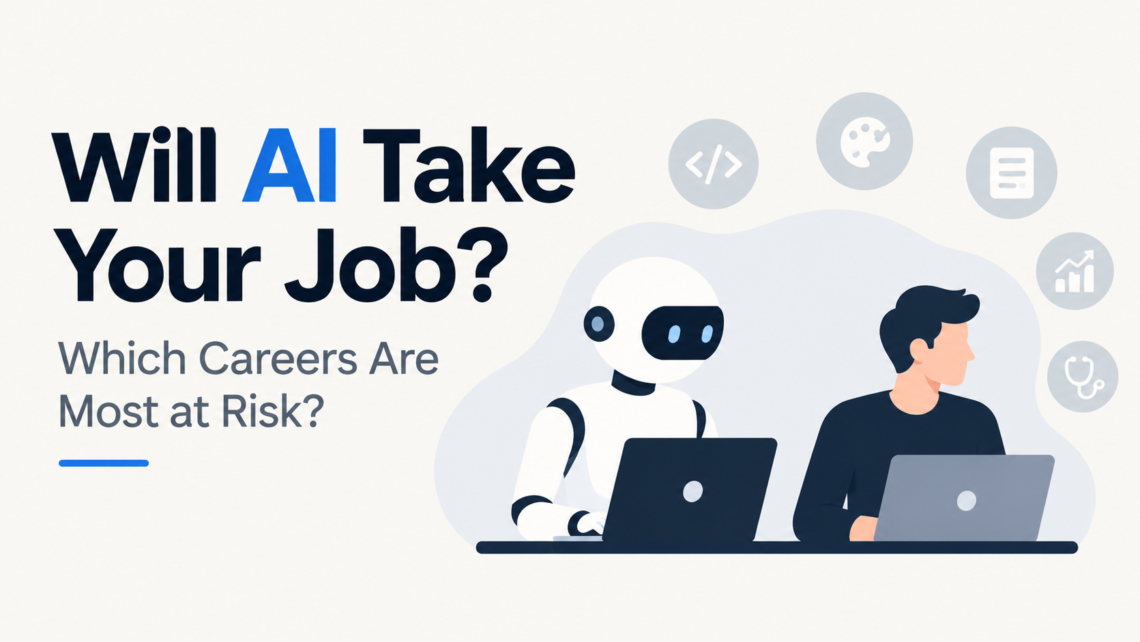
Will AI Take Your Job?
For most people, the more useful question isn’t:
“Will AI take my job?”
It’s:
“Which parts of my job can AI automate, and how can I become better at the parts it can’t?”
If your work contains many repetitive digital tasks, AI is likely to have a significant impact.
If your work requires physical skills, human relationships, unpredictable environments, or complex judgment, complete automation may be more difficult.
But almost every profession can potentially be affected.
How to Prepare for an AI-Powered Workplace
You don’t necessarily need to become an AI engineer.
Instead, start by understanding how AI can be applied to your existing work.
Learn how to:
- Use AI assistants effectively
- Automate repetitive tasks
- Verify AI-generated information
- Analyze AI-generated results
- Understand basic AI limitations
- Develop stronger communication skills
- Build expertise in your industry
The goal isn’t to compete with AI at the tasks it performs best.
The goal is to use AI to increase your own capabilities.
Final Thoughts
AI will almost certainly change the job market.
Some jobs will shrink. Some tasks will disappear. Some careers will be transformed, and entirely new opportunities will emerge.
But the idea that AI will simply replace every human worker is far too simplistic.
The biggest impact is likely to come from task automation.
Jobs consisting largely of repetitive, predictable digital work are more exposed, while jobs requiring physical skills, human relationships, judgment, responsibility, and complex real-world problem solving may be harder to automate completely.
The workplace of the future may therefore contain fewer people doing repetitive tasks and more people directing, reviewing, and collaborating with intelligent systems.
AI isn’t just becoming a tool for replacing work.
It’s becoming a tool for changing what work looks like.
And for many workers, the most important career decision won’t be whether to compete against AI—it will be learning how to work alongside it.