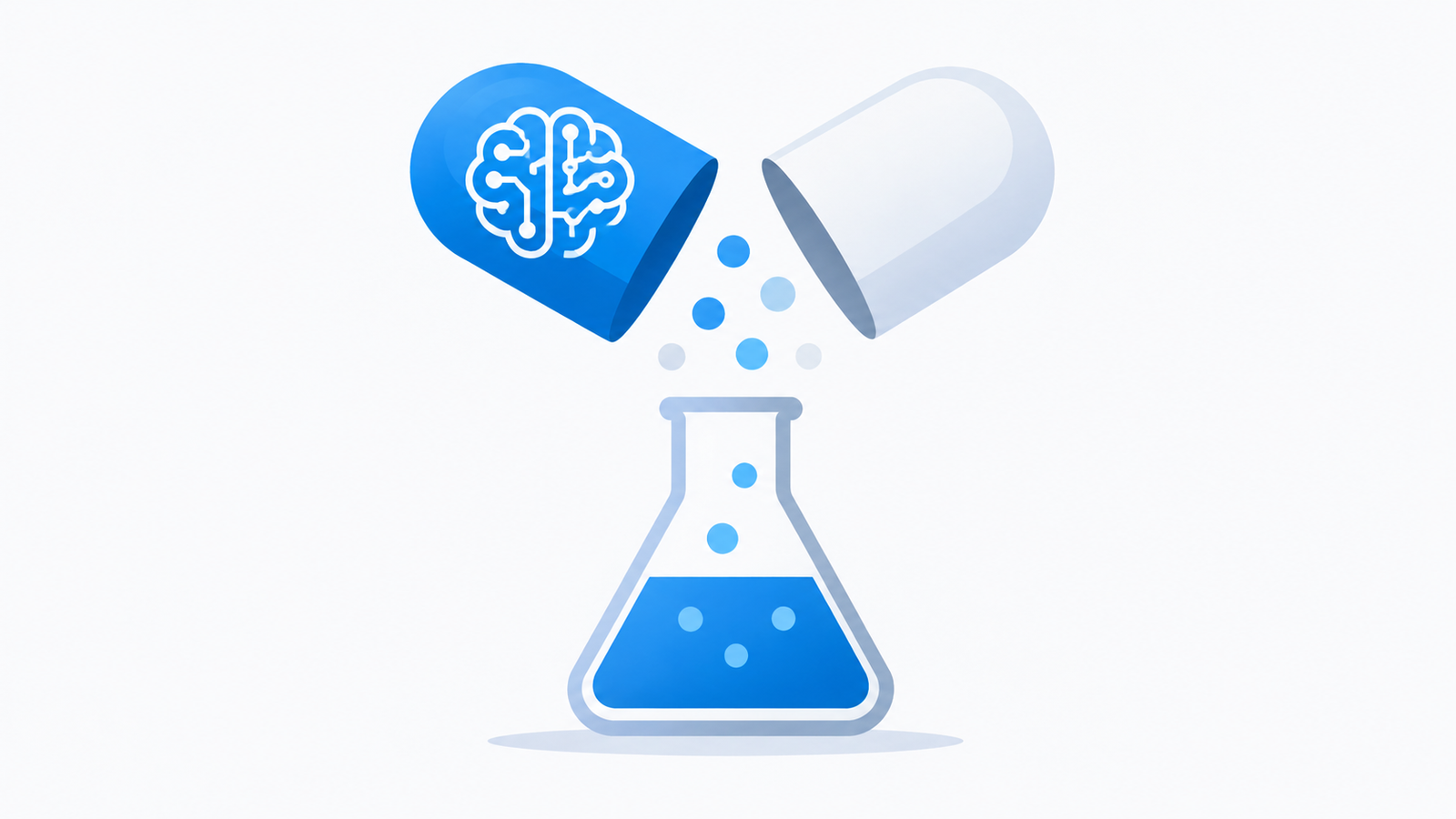
Discovering a new medicine is one of the most complicated and expensive processes in modern science. Researchers must identify a disease-related biological target, find a promising compound, test its effects, evaluate its safety, and eventually determine whether it works in human patients. This process can take many years, and a large proportion of experimental drug candidates never become approved treatments.
Artificial intelligence is beginning to change how pharmaceutical researchers approach this challenge. Instead of relying entirely on traditional laboratory experiments and manual screening, scientists can use AI models to analyze biological data, predict molecular interactions, identify potential drug targets, and design entirely new chemical compounds.
Some of these developments have already produced promising experimental results and even candidates that have entered human clinical trials.
But can AI actually discover medicines faster than traditional research? And does finding a promising molecule mean scientists are closer to producing a successful treatment?
The answer is promising, but more complicated than the headlines suggest.
What Is AI Drug Discovery?
AI drug discovery refers to the use of machine learning, deep learning, generative AI, and computational models to support different stages of pharmaceutical research.
Traditional drug discovery often involves screening large collections of chemical compounds to identify molecules that might interact with a biological target associated with a disease.
Researchers then investigate promising candidates through laboratory experiments, refine their chemical structures, and conduct further testing.
AI introduces another approach. It can learn patterns from enormous datasets containing information about proteins, chemical structures, biological activity, genetic information, and previously studied medicines.
Using these patterns, an AI system can help researchers:
- Identify potential drug targets.
- Predict how proteins are structured.
- Estimate how molecules might interact with biological targets.
- Generate new chemical compounds.
- Screen large chemical libraries.
- Predict certain drug properties and possible toxicity.
- Prioritize candidates for laboratory testing.
The objective is not simply to make pharmaceutical research more automated. It is to help scientists identify promising candidates more efficiently and avoid spending time and resources on compounds that are unlikely to succeed.
This is also an example of how artificial intelligence is changing software development, with advanced computing systems increasingly being applied to complex problems outside traditional technology industries.
How Does AI Discover New Medicines?
AI drug discovery combines several technologies, each addressing a different part of the research process.
1. Identifying Biological Targets
Before developing a medicine, scientists need to understand what biological process they want to influence.
A drug target may be a protein, enzyme, receptor, or another biological component involved in a disease.
For example, a particular protein might contribute to inflammation, cancer growth, or the progression of a neurological condition.
Researchers investigate these targets using laboratory experiments, genetic studies, clinical observations, and existing scientific literature.
AI models can analyze large biological datasets to identify patterns that might otherwise be difficult to detect.
They may help researchers find relationships between genes, proteins, and diseases or identify biological targets that deserve further investigation.
However, a statistical relationship does not automatically establish that a target causes a disease. Scientists still need experimental evidence to understand whether changing that target could produce a useful medical effect.
2. Predicting Protein Structures
Proteins perform many essential functions in the human body. Their three-dimensional structures influence how they interact with other molecules, including potential medicines.
Understanding these structures has traditionally required demanding experimental techniques, such as X-ray crystallography and cryo-electron microscopy.
AI has introduced a powerful alternative for predicting protein structures.
One of the most influential developments is AlphaFold, developed by Google DeepMind. AlphaFold2 demonstrated that AI could predict many protein structures with remarkable accuracy, while AlphaFold3 expanded the ability to model interactions involving proteins and other biological molecules.
This is important because researchers need to understand the shape and behavior of biological targets before designing compounds that interact with them.
The AlphaFold Protein Structure Database has made a huge collection of predicted structures accessible to researchers around the world.
However, a predicted structure is not the same as a complete understanding of how a biological system behaves. Proteins can change shape, interact with different molecules, and behave differently under different biological conditions.
For more information, see AlphaFold’s scientific research and resources.
3. Designing New Drug Molecules
One of the most exciting applications of generative AI is its ability to propose new chemical structures.
Traditional screening usually begins with compounds that already exist in a chemical library. Researchers test these molecules to identify those with potentially useful biological activity.
Generative AI takes a different approach.
A model learns patterns from existing chemical structures and can use those patterns to generate new molecular designs. Researchers can guide the model toward compounds with desired properties, such as the ability to interact with a particular target.
The generated molecules can then be evaluated using computational models before scientists decide which candidates should be synthesized and tested.
This allows researchers to explore chemical possibilities that may not be represented in existing compound libraries.
Importantly, generating a molecule on a computer does not establish that it can be manufactured, safely administered, absorbed by the body, or used as an effective medicine.
Those questions require additional research.
4. Predicting Drug Properties
A promising molecule must satisfy several requirements before it can become a potential medicine.
It needs to reach the appropriate part of the body, interact with its intended target, remain sufficiently stable, and avoid unacceptable toxicity.
Researchers often evaluate these properties using ADMET analysis:
- Absorption: How the drug enters the bloodstream.
- Distribution: How it travels through the body.
- Metabolism: How the body processes the drug.
- Excretion: How the drug is eliminated.
- Toxicity: Whether it causes harmful effects.
AI models can help estimate some of these properties and prioritize molecules for further testing.
This may reduce unnecessary laboratory work, but predictions are not definitive proof of safety. Human biology is extremely complex, and computational estimates cannot replace experimental and clinical evaluation.
5. Testing and Improving Drug Candidates
After AI identifies promising molecules, researchers must test them experimentally.
This typically involves several stages:
- Synthesizing or obtaining the selected compounds.
- Testing their activity in laboratory experiments.
- Investigating how they interact with biological targets.
- Evaluating toxicity and other safety properties.
- Testing promising candidates in appropriate animal models.
- Selecting candidates for human clinical trials.
The results can then be used to improve the next generation of AI predictions.
This creates a feedback loop in which computational models suggest experiments, laboratory results provide new information, and researchers use that information to refine their models.
MIT’s Antibiotics-AI Project uses this type of approach, combining machine learning with experimental biology to discover and design potential antibiotics.
Real Breakthroughs: Where Has AI Drug Discovery Already Succeeded?
AI drug discovery is no longer limited to theoretical demonstrations. Researchers have published several examples in which AI-assisted methods produced experimentally tested compounds.
However, it is important to distinguish between a compound that works in a laboratory experiment, one that produces promising results in animals, and a medicine that has demonstrated safety and effectiveness in human clinical trials.
1. Rentosertib: An AI-Discovered Drug Reaches Phase 2a Trials
One of the most important examples is rentosertib, formerly known as ISM001-055, developed by Insilico Medicine.
The drug was designed using a generative AI-driven discovery process and targets TNIK, a protein associated with idiopathic pulmonary fibrosis (IPF).
IPF is a progressive lung disease in which lung tissue becomes scarred, making breathing increasingly difficult. Existing treatments can slow disease progression in some patients, but they do not reverse the underlying scarring.
In June 2025, researchers published results from a randomized Phase 2a clinical trial in Nature Medicine.
The study involved 71 patients and evaluated different doses of rentosertib against a placebo over 12 weeks.
The researchers reported:
- Similar overall rates of treatment-emergent adverse events across the treatment groups and placebo group.
- A mean improvement in forced vital capacity of 98.4 milliliters in the 60 mg once-daily group.
- A mean change of minus 20.3 milliliters in the placebo group.
Forced vital capacity measures the amount of air a person can forcibly exhale after taking a deep breath.
The findings were encouraging, but the trial was relatively small and short. The researchers concluded that further, larger clinical trials were needed to investigate the treatment’s safety and effectiveness.
Why does this matter?
Rentosertib provides a significant demonstration that an AI-discovered drug candidate can progress beyond computational research and enter a controlled human clinical trial.
It does not establish that AI-designed medicines are already more successful than traditionally discovered medicines, nor does it mean rentosertib is an approved treatment.
Research source: Nature Medicine – A generative AI-discovered TNIK inhibitor for idiopathic pulmonary fibrosis
2. AI-Designed Antibiotics Against Drug-Resistant Bacteria
Antibiotic resistance is one of the most serious challenges facing modern medicine.
Bacteria can evolve mechanisms that allow them to survive treatments that previously worked. As resistance spreads, infections become more difficult to treat.
Researchers at MIT have been investigating whether generative AI can help discover entirely new antibiotic compounds.
In August 2025, MIT reported research in which scientists used generative AI approaches to design new molecules targeting drug-resistant bacteria.
The researchers computationally explored more than 36 million possible compounds and identified promising candidates with structures different from existing antibiotics.
Some of the resulting compounds showed activity against difficult-to-treat bacterial infections, including multidrug-resistant Staphylococcus aureus (MRSA) and drug-resistant Neisseria gonorrhoeae.
The researchers also investigated how these molecules worked, finding evidence that some disrupted bacterial cell membranes.
This is particularly interesting because AI was not simply searching through existing medicines. It was helping scientists generate new molecular structures that could potentially form the basis of future antibiotics.
However, these findings represent an early stage of drug development. Experimental antibacterial activity does not establish that a compound will be safe or effective in people.
Research sources:
- MIT – Using generative AI, researchers design compounds that can kill drug-resistant bacteria
- MIT Antibiotics-AI Project
3. AlphaFold: Changing How Scientists Understand Proteins
AlphaFold represents a different kind of breakthrough.
Rather than directly producing a medicine, it helps scientists understand the biological structures that medicines are designed to interact with.
Before AI-based protein prediction became widely available, determining protein structures could require substantial experimental effort.
AlphaFold made it possible to predict structures for a huge range of proteins, expanding access to structural information.
This has helped researchers investigate proteins that were previously difficult to study and has supported research across structural biology.
AlphaFold3 extended this work by predicting interactions between proteins and other biological molecules, including certain ligands and nucleic acids.
Nevertheless, predicting molecular structures is only one part of drug discovery. A predicted interaction does not necessarily mean that a compound will produce the desired biological effect.
Research resource: AlphaFold Protein Structure Database
AI Drug Discovery vs Traditional Drug Discovery
AI is changing how researchers approach pharmaceutical research, but it has not eliminated traditional laboratory methods.
The two approaches are increasingly being combined.
| Area | Traditional approach | AI-assisted approach |
|---|---|---|
| Target identification | Experimental research and scientific analysis | Analysis of large biological datasets |
| Protein structures | Experimental structural biology | AI-based structure prediction alongside experiments |
| Molecule discovery | Screening existing chemical libraries | Screening plus generative molecular design |
| Candidate selection | Laboratory measurements and established models | Computational predictions combined with experiments |
| Drug optimization | Repeated medicinal chemistry experiments | AI-assisted predictions and molecular refinement |
| Safety evaluation | Laboratory, animal, and clinical testing | AI predictions alongside required testing |
| Clinical trials | Human testing and clinical evidence | Human testing and clinical evidence |
The most important distinction is that AI can improve the process used to identify and prioritize drug candidates, but the fundamental requirements for demonstrating a medicine’s safety and effectiveness remain.
Can AI Really Discover Medicines Faster?
AI can accelerate selected parts of drug discovery, but there is no single verified percentage by which it makes the entire pharmaceutical development process faster.
Its advantages are particularly visible during early-stage research.
For example, an AI model can evaluate enormous numbers of hypothetical molecules computationally, helping researchers identify a smaller group worth investigating experimentally.
It can also help scientists examine biological datasets, predict protein structures, and prioritize potential targets.
These capabilities may reduce the time spent on certain repetitive or computationally demanding tasks.
However, the overall drug development process includes much more than finding a molecule.
Clinical trials require patient recruitment, treatment periods, monitoring, data analysis, and regulatory review. These stages cannot simply be removed because an AI model has identified a promising compound.
A 2026 perspective published in Nature Reviews Drug Discovery provides an important reality check. Its authors concluded that evidence of AI’s clinically meaningful impact remains limited, despite substantial advances in computational capabilities.
The review also highlights a major distinction: improving molecular design and prediction does not automatically translate into more approved medicines.
In other words, AI may make parts of drug discovery faster without necessarily making the entire process equally faster.
What Are the Limitations of AI Drug Discovery?
Despite its progress, AI drug discovery faces several scientific and practical challenges.
1. Predictions Are Not Always Accurate
AI models learn from existing data. If that information is incomplete, biased, or poorly representative of real biological conditions, predictions may be unreliable.
A molecule that appears promising in a computational model may fail when tested in a laboratory.
2. Human Biology Is Extremely Complex
The human body contains interconnected biological systems.
A medicine may interact with its intended target but also affect other proteins, tissues, or biological pathways.
These unexpected interactions can produce side effects or reduce the effectiveness of a treatment.
Predicting the behavior of an entire biological system remains much more difficult than predicting the structure of an individual protein.
3. Clinical Trials Still Take Time
Even when a promising candidate has been identified, it must pass through several stages of clinical evaluation.
These commonly include:
- Phase 1: Initial evaluation of safety, tolerability, and dosage, usually in a small group of participants.
- Phase 2: Investigation of preliminary effectiveness and further safety assessment in patients with the condition.
- Phase 3: Larger studies designed to confirm effectiveness and monitor safety.
- Regulatory review: Evaluation of the available evidence before a medicine can be approved.
AI cannot establish clinical effectiveness simply by predicting how a molecule will behave.
4. High-Quality Data Is Difficult to Obtain
Drug discovery requires reliable information about chemical compounds, biological targets, diseases, and experimental outcomes.
However, scientific datasets can contain missing information, inconsistent measurements, and results from different experimental conditions.
Models trained on one dataset may not perform as expected when applied to another.
5. Computational Success Does Not Guarantee Commercial Success
A compound may demonstrate promising biological activity but still fail because it is difficult to manufacture, too expensive to develop, unstable, or unsuitable for the intended patient population.
Pharmaceutical development also involves intellectual property, manufacturing capacity, regulatory requirements, and commercial considerations.
AI can help with some of these challenges, but it cannot eliminate them.
How AI Could Change the Pharmaceutical Industry
The impact of AI drug discovery may extend beyond individual research laboratories.
Pharmaceutical companies could increasingly use AI to support research planning, identify promising biological targets, and prioritize compounds before committing substantial resources to laboratory experiments.
More Efficient Research Workflows
AI systems could help researchers process scientific information and identify patterns across large collections of experimental results.
This could make certain research activities more efficient and reduce unnecessary duplication.
Greater Exploration of Rare Diseases
Many rare diseases have limited treatment options because their biological mechanisms are difficult to understand and the commercial incentives for traditional drug development can be limited.
AI may help researchers analyze genetic and biological information to identify potential targets and investigate new treatment approaches.
This does not guarantee that rare diseases will receive new medicines, but it could expand the range of research possibilities.
New Antibiotics
AI-generated molecular design could help researchers investigate chemical structures beyond those found in existing antibiotic libraries.
This is particularly relevant as antimicrobial resistance continues to create challenges for healthcare systems.
Personalized Medicine
Combining AI with genetic information, medical imaging, and patient data could help researchers investigate why certain treatments work better for some patients than others.
In the future, these approaches may support more individualized treatment strategies.
However, using AI to personalize treatments requires careful validation, reliable data, and strong privacy protections.
What Comes Next for AI Drug Discovery?
The next stage of AI drug discovery will likely focus less on generating impressive predictions and more on proving that those predictions improve real pharmaceutical research.
Several developments could shape the field.
AI and automated laboratories: Researchers may increasingly connect computational models with robotic laboratory systems that can perform experiments and return results to the models.
Improved biological simulations: Better models may help scientists understand interactions between proteins, cells, and complex biological systems.
More accurate molecular design: Generative models may improve their ability to create compounds with multiple desirable properties rather than focusing on a single biological target.
AI-assisted clinical research: AI could support patient selection, clinical trial planning, data analysis, and the identification of potential safety signals.
More transparent scientific validation: Researchers and regulators will increasingly need evidence that AI systems are reliable for the specific tasks they are designed to perform.
In January 2026, the FDA and European Medicines Agency published guiding principles for good AI practice in drug development. These principles emphasize reliability, appropriate oversight, and the management of AI systems throughout the drug product lifecycle.
This reflects an important shift: the industry is moving beyond asking what AI can predict and toward determining how those predictions can be used responsibly in real drug development.
Regulatory resource: FDA and EMA – Guiding Principles of Good AI Practice in Drug Development
Final Thoughts: Is AI the Future of Medicine Discovery?
AI is already changing how scientists search for potential medicines. It can analyze biological information, predict protein structures, generate new chemical compounds, and help researchers prioritize candidates for experimental testing.
The progress made with rentosertib, AI-designed antibiotics, and AlphaFold demonstrates that these technologies are more than theoretical possibilities.
However, there is still a considerable difference between discovering a promising molecule and developing an approved medicine.
Clinical safety, effectiveness, manufacturing, and regulatory evaluation remain essential. AI can support these processes, but it cannot replace the scientific evidence required to establish that a treatment works.
The most realistic future is not one in which AI independently replaces pharmaceutical researchers. Instead, it is one in which AI and human scientists work together, using computational tools to explore possibilities and laboratory research to establish what actually works.
If this collaboration continues to improve, AI could become one of the most important technologies supporting the next generation of medical discoveries.
Frequently Asked Questions
1. Can AI discover new medicines?
Yes. AI can help identify biological targets, predict protein structures, and generate potential drug molecules. Several AI-assisted candidates have been experimentally tested, and some have entered human clinical trials.
2. Has an AI-discovered drug been tested in humans?
Yes. Rentosertib, developed by Insilico Medicine using generative AI-driven discovery, reached a randomized Phase 2a clinical trial for idiopathic pulmonary fibrosis. Its results were published in Nature Medicine in June 2025.
3. Can AI replace traditional drug discovery?
No. AI can support and improve parts of traditional research, but laboratory experiments, animal studies where appropriate, human clinical trials, and regulatory evaluation remain necessary.
4. How does AI identify potential medicines?
AI models analyze chemical structures, biological datasets, and molecular interactions. They can identify promising compounds, predict certain drug properties, and generate new molecular designs for researchers to investigate.
5. What is AlphaFold and why is it important for drug discovery?
AlphaFold is an AI system developed by Google DeepMind that predicts protein structures. Its predictions provide researchers with structural information that can help them investigate biological targets and potential drug interactions.
6. Can AI help develop antibiotics?
Yes. Researchers have used generative AI to design new compounds with activity against drug-resistant bacteria. Some candidates have demonstrated promising results in laboratory and animal studies, but further testing is needed before they can become approved antibiotics.
7. Does AI make drug development cheaper?
AI may reduce costs in certain early research activities by improving screening, prioritization, and molecular design. However, there is not yet enough evidence to conclude that AI consistently reduces the total cost of developing an approved medicine.
8. What are the biggest limitations of AI in medicine discovery?
Important limitations include incomplete datasets, inaccurate predictions, complex human biology, unexpected toxicity, and the difficulty of translating laboratory results into successful clinical treatments.
9. Will AI create personalized medicines?
AI could help researchers analyze genetic, clinical, and biological information to investigate treatments tailored to individual patients. However, widespread personalized drug development still requires substantial clinical validation.
10. What is the future of AI drug discovery?
Future developments may include more accurate molecular design, automated laboratories, improved biological simulations, AI-assisted clinical trials, and closer collaboration between computational researchers and pharmaceutical scientists.