
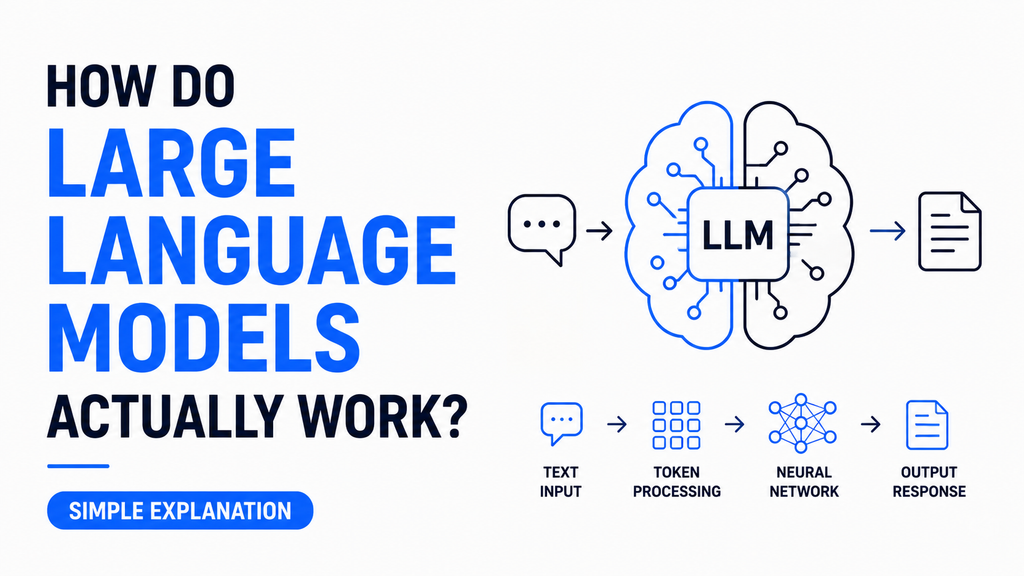
Large Language Models, commonly called LLMs, are behind many of today’s AI tools. They can answer questions, write articles, summarize documents, translate languages, generate code, and hold conversations that feel surprisingly natural.
But how do they actually work?
You don’t need to understand advanced mathematics or computer science to understand the basic idea. At a high level, an LLM learns patterns from enormous amounts of text and then uses those patterns to predict what should come next.
Let’s break it down step by step.
What Is a Large Language Model?
A Large Language Model is a type of artificial intelligence designed to understand and generate human language.
Examples of applications powered by language models include AI chatbots, writing assistants, coding assistants, search tools, and customer-service systems.
The word “large” refers mainly to the enormous number of parameters used by these models and the huge amount of data and computing power involved in training them.
A simple way to think about an LLM is:
It reads a piece of text, understands the patterns in it, and predicts what text should come next.
That sounds simple, but doing this well requires an enormous neural network.
Step 1: The Model Learns From Text
Before an LLM can answer questions, it needs to be trained.
During training, the model processes huge quantities of text from sources such as books, websites, articles, documents, and other datasets, depending on how the particular model was developed.
Imagine giving a student millions of examples of language:
- “The sky is…”
- “The computer uses…”
- “Water freezes at…”
- “The fastest way to…”
The student gradually learns relationships between words, sentences, concepts, and ideas.
An LLM does something similar, but using mathematical representations and neural networks rather than human understanding.
Step 2: Text Is Broken Into Tokens
Computers don’t process language exactly like humans do.
Before text enters the model, it is divided into smaller pieces called tokens.
A token can be:
- A complete word
- Part of a word
- A punctuation mark
- A number
- Sometimes a combination of characters
For example, a sentence such as:
“Artificial intelligence is changing technology.”
might be broken into several tokens.
The exact way this happens depends on the model’s tokenizer.
The important thing to understand is that the model doesn’t literally see the sentence as a human sees it. It processes a sequence of numerical representations associated with those tokens.
Step 3: Tokens Become Numbers
Neural networks work with numbers, so the tokens need to be represented mathematically.
This is where embeddings become important.
An embedding converts a token into a collection of numbers that represents information about its relationship to other tokens.
You can imagine words being placed in a huge mathematical space.
Words that frequently appear in similar contexts can end up with related representations.
For example, concepts such as:
computer → processor → software → programming
may have relationships that the model can represent mathematically.
The model isn’t simply storing a dictionary definition for every word. Instead, it learns complicated statistical relationships between tokens and their surrounding context.
Step 4: The Transformer Does the Heavy Work
One of the most important technologies behind modern LLMs is the Transformer architecture.
Transformers changed language AI because they can process relationships between different parts of a sequence very effectively.
A key component is called attention.
What Is Attention?
Imagine reading this sentence:
“The laptop was placed on the desk because it was heavy.”
To understand what “it” refers to, you need to consider the surrounding words.
Attention allows the model to examine relationships between tokens and determine which parts of the context are more relevant to the current prediction.
For example, when processing a particular word, the model can assign different levels of importance to other words in the sequence.
This is called self-attention.
It allows the model to consider context rather than treating every word independently.
Step 5: The Model Predicts the Next Token
This is the fundamental idea behind language generation.
Suppose you write:
“The capital of France is…”
The model calculates probabilities for possible next tokens.
Something like:
- Paris — very high probability
- London — low probability
- Berlin — low probability
- Computer — extremely low probability
The model selects a token according to its generation process.
Then the process repeats.
For example:
“The capital of France is”
→ “Paris”
Then:
“The capital of France is Paris”
The model predicts what comes next.
This happens again and again until it produces a complete response.
Does That Mean Chatbots Are Just Guessing?
In a sense, yes—but “guessing” is an oversimplification.
The model isn’t randomly choosing words.
Its predictions are based on extremely complex patterns learned during training.
For example, if you ask:
“What is 2 + 2?”
the model has encountered enormous numbers of examples involving arithmetic and the relationship between those symbols.
Its neural network produces a very strong probability for the appropriate response.
However, an important limitation remains:
A language model can produce a convincing answer that is incorrect.
This is one reason AI-generated information should sometimes be checked against reliable sources.
What Are Parameters?
You may hear AI companies talk about a model having billions or even trillions of parameters.
Parameters are adjustable numerical values inside the neural network.
During training, these values are repeatedly adjusted so that the model becomes better at predicting the correct next token.
Think of parameters as millions or billions of tiny numerical settings that collectively determine how the model responds to input.
The model doesn’t manually write rules such as:
“If someone says hello, respond with hello.”
Instead, the behavior emerges from the enormous network of learned parameters.
How Does Training Actually Happen?
Training an LLM requires enormous amounts of computing power.
The basic process looks roughly like this:
1. Give the model text
The model receives a sequence of tokens.
2. Hide or predict the next token
The model attempts to predict what should come next.
3. Compare the prediction
The prediction is compared with the actual token.
4. Calculate the error
The system determines how wrong the prediction was.
5. Adjust the parameters
A mathematical optimization process changes the model’s parameters slightly.
6. Repeat
This process happens over an enormous number of examples.
After countless iterations, the model becomes increasingly capable of predicting language patterns.
What Is Fine-Tuning?
Initial training gives a model broad language capabilities, but developers can further train or adjust models for specific purposes.
This process is often called fine-tuning.
For example, a model might be adapted to become better at:
- Following instructions
- Writing code
- Answering customer questions
- Summarizing documents
- Working with particular types of content
Additional techniques can also be used to make models more useful, safer, and better at following instructions.
Why Can LLMs Write So Naturally?
This is where the scale of modern models becomes important.
During training, the model encounters countless examples of how language is structured.
It can learn relationships involving:
- Grammar
- Sentence structure
- Vocabulary
- Writing styles
- Common facts
- Programming patterns
- Relationships between concepts
- Different languages
Because the model considers context across many tokens, it can generate text that appears coherent and connected.
It’s not simply looking up sentences from a database and copying them.
Instead, it generates new sequences based on the patterns represented within its parameters and the context provided to it.
Do LLMs Actually Understand Language?
This is a much more complicated question.
LLMs can demonstrate impressive abilities that look like understanding. They can explain concepts, follow instructions, translate text, reason through many problems, and maintain context within a conversation.
However, an LLM doesn’t experience the world like a human.
It doesn’t have human consciousness, emotions, personal experiences, or physical senses simply because it has learned language.
Its capabilities come from computational processing of patterns and representations learned from data.
This distinction is important when thinking about what AI can and cannot do.
How Does an LLM Remember Your Conversation?
When you’re chatting with an AI, previous messages can be included as part of the model’s context.
The model then processes your current message together with relevant previous information.
For example:
You: “My favorite programming language is Python.”
You: “What language do I like?”
The system can use the earlier message as context when generating the response.
However, this doesn’t necessarily mean the model permanently remembers everything you’ve ever said. Different AI systems have different approaches to conversation history and optional memory features.
What Is a Context Window?
A language model can only process a certain amount of information at once.
This is called its context window.
The context can include things such as:
- Your current question
- Previous messages
- Documents
- Instructions
- Other information provided to the model
Modern models can have very large context windows, allowing them to work with substantial documents and long conversations.
But there is still a limit.
Why Do LLMs Sometimes Make Mistakes?
One of the biggest misconceptions about AI is that a fluent response must be correct.
That’s not necessarily true.
An LLM’s primary job is to generate a likely sequence of tokens based on its training and context.
It isn’t automatically connected to a perfect database of facts.
As a result, it can sometimes:
- Give incorrect facts
- Misunderstand a question
- Make calculation errors
- Invent sources or information
- Provide outdated information
- Confidently explain something incorrectly
These incorrect AI-generated responses are commonly called hallucinations.
Can LLMs Search the Internet?
Some AI systems can use external tools such as web search, databases, calculators, or other software.
This is different from the language model itself.
For example, an AI system could work like this:
User question → Language model → Search tool → Information retrieved → Language model → Final answer
Using external tools can help an AI system obtain current information rather than relying entirely on what was learned during training.
How Does AI Generate Code?
The same basic prediction mechanism can be applied to programming languages.
During training, models can learn patterns found in programming code.
If you ask:
“Write a Python function that calculates the average of a list.”
the model generates code token by token based on learned programming patterns and your instructions.
This is why modern LLMs can be surprisingly capable programming assistants.
Why Are GPUs Used?
Training and running large neural networks involves huge numbers of mathematical operations.
GPUs, or Graphics Processing Units, are particularly useful because they can perform many mathematical calculations in parallel.
Large AI systems can therefore require enormous computing infrastructure containing large numbers of specialized processors.
This is one reason developing and operating advanced AI models can be extremely expensive.
A Simple Example of an LLM
Imagine an extremely advanced autocomplete system.
You type:
“The sun rises in the…”
The model predicts:
“east”
Then it sees:
“The sun rises in the east…”
and predicts what comes next.
Now imagine that this autocomplete system has:
- A massive neural network
- Billions of learned parameters
- Huge amounts of training data
- Sophisticated attention mechanisms
- Powerful computing hardware
The result is something far more capable than ordinary smartphone autocomplete.
That’s a simplified way to visualize an LLM.
LLMs Are More Than Simple Autocomplete
Calling an LLM “autocomplete” is useful for explaining the basic mechanism, but it doesn’t capture everything modern models can do.
Large models can develop sophisticated capabilities from the patterns learned during training.
They can:
- Analyze documents
- Summarize information
- Translate languages
- Generate software
- Explain technical concepts
- Extract information
- Follow complex instructions
- Transform text
- Solve many types of problems
The underlying generation process still involves predicting tokens, but the internal representations learned by large neural networks can support surprisingly complex behavior.
The Basic Process in One Diagram
You can think of an LLM like this:
Your question
↓
Tokenization
↓
Tokens converted into numerical representations
↓
Transformer processes the context
↓
Attention identifies important relationships
↓
Neural network calculates probabilities
↓
Next token is selected
↓
Process repeats
↓
Complete response
This entire process can happen incredibly quickly.
Final Thoughts
Large Language Models may seem mysterious, but the core concept is surprisingly straightforward.
They are neural networks trained on enormous amounts of data to learn patterns in language and predict sequences of tokens.
Technologies such as transformers, attention mechanisms, embeddings, and billions of learned parameters allow these models to process context and generate remarkably sophisticated responses.
The important thing to remember is that an LLM isn’t simply a giant database of answers. It generates responses using patterns learned during training and information available in its current context.
That’s what makes LLMs so powerful—and also why they can sometimes make mistakes.
As AI continues to develop, understanding this basic process makes it much easier to understand everything from chatbots and AI search to coding assistants, content-generation tools, and the increasingly large infrastructure being built to run them.